
AS4480.1 is the Australian Standard for medical sheepskins: a specification published by Standards Australia on 5 May 1998 that sets out what a tanned sheepskin or lambskin must meet before it can be sold for health care use. It covers the wool, the leather, the size, the color and how well the skin survives hot washing, and a sheepskin that meets it carries a stamp on its leather back. Down-Under Wool has supplied Australian sheepskins made to this standard since 1988, and this guide explains who wrote AS4480.1, what it tests, how to read the stamp, and why certification is worth paying for.

What is AS4480.1?
AS4480.1 is the Australian Standard that defines a medical grade sheepskin. Its full title is "Textiles for health care facilities and institutions: Medical sheepskins, Part 1: Product specification and testing" (AS 4480.1-1998). The standard applies to woolskins, which means tanned sheepskins and lambskins, made for health care, medical and institutional use, where they are used to reduce pressure, friction and humidity between a person and the bed or chair beneath them.
In plain terms, AS4480.1 is the difference between a decorative sheepskin rug and a medical sheepskin. Two skins can look alike in a photo; only one of them has been made and tested to a published specification. Standards Australia still lists AS 4480.1-1998 as a current standard.
Who wrote the AS4480.1 standard?
AS4480.1 was published by Standards Australia, the country's national standards body, and prepared by its textiles committee (TX/15). The research behind it came from the CSIRO, Australia's national science agency. According to the authors of the 2004 Medical Journal of Australia trial, the CSIRO's Leather Research Centre coordinated the development of the standard, and in 1998 the CSIRO introduced a new medical sheepskin with a denser, higher wool pile that can withstand repeated washing at 80°C (176°F).
That last point is the reason the standard exists. Older sheepskins often went hard and shrank after hospital laundering, which made them uncomfortable and much less useful. AS4480.1 was written so that a hospital, a nursing home or a family could buy a sheepskin and know it would stay soft through repeated hot washes.
What does AS4480.1 test?
AS4480.1 tests the wool, the leather and the finished size of each sheepskin. The standard's own table of contents lists these manufacturing requirements:
| What AS4480.1 checks | Why it matters to the person using it |
|---|---|
| Wool fiber diameter | Fiber thickness decides how soft the wool feels against the skin. |
| Wool pile height | A deep pile is what cushions the body and spreads its weight. |
| Softness and drape; flatness | The skin should lie flat and mold to the body without ridges that create new pressure points. |
| Degree of tannage | Decides how hot the water can be before the leather shrinks. |
| Maintenance of shrinkage temperature | Checks that the leather still resists heat after it has been washed and dried. |
| Colorfastness | The dye should not run or fade in the wash. |
| Dimensions | Sets the size of the skin, which decides how much of the body it protects. |
| Wool color for Australian institutional use | Makes a medical sheepskin easy to recognize on a ward. |
| Manufacturer's labelling and supplier's label | Every compliant skin is marked so buyers can identify it. |
The researchers who tested these sheepskins in hospitals describe the result as a leather-backed skin with a dense, uniform 25 mm (1 inch) natural wool pile. Our own M102C Australian Medical Sheepskin has a 30 mm (1.2 inch) pile. If you want the research behind these properties, our wool and sheepskin testing page collects it.
What does the AS4480.1 stamp look like?
The AS4480.1 stamp is a rectangular mark printed on the leather back of the sheepskin, framed by the words "Australian Medical Sheepskin" with a green cross at each corner and in the center. Part the wool and turn the skin over to find it. Inside the frame you will see:
- The grade, for example "HITEMP UR": HiTemp wash and urine resistant.
- The standard number, "AS 4480.1".
- A size box for the size of that skin.
- A manufacturer ID (marked MNF I.D), which identifies the tannery that made it.

The stamp matters because color alone proves nothing: plenty of green-dyed sheepskins sold online are not made to the standard. Australian funding schemes look for the stamp too. Victoria's State-wide Equipment Program, for example, funds only dark green sheepskins that carry the standards stamp or tag of the high-temperature AS4480.1 grade. For a full list of checks before you buy, see our medical sheepskin buyer's checklist.
What are the HiTemp and RegTemp grades?
AS4480.1 recognizes two washing grades: HiTemp sheepskins, which can be laundered hot, and RegTemp sheepskins, which need cooler water. The standard includes a user's guide for each grade. HiTemp skins, usually dyed green, are the ones made to withstand repeated washes at 80°C (176°F), the temperature used for thermal disinfection in hospitals. The letters "UR" after HiTemp mean the leather is tanned to be urine resistant.
We explain both terms, and who needs them, in what "HiTemp UR" means. If urine resistance is your main concern, our comparison of urine-resistant and non-urine-resistant wool products covers it in detail.
Why does AS4480.1 certification matter?
Certification matters because the clinical evidence for medical sheepskin comes from sheepskins made to AS4480.1, not from sheepskins in general. Three examples:
- The 2004 hospital trial. In a randomized trial of 441 patients at a Melbourne teaching hospital, patients who lay on an AS4480.1 sheepskin developed new pressure ulcers at 9.6%, compared with 16.6% of those given usual care.
- The pooled analysis. A 2010 analysis of three randomized trials, covering 1,281 patients in 11 hospitals and nursing homes, found sacral pressure ulcers in 5.4% of patients on the sheepskin and 12.2% of controls.
- Washing. A skin that hardens after a few washes loses its softness and cushioning. AS4480.1 tests the leather after washing, and our Australian Medical Sheepskin Overlay (M102) is warranted for at least 50 washes in Woolskin when the care instructions are followed.
Put simply, an uncertified sheepskin may be soft and pleasant, but there is no published evidence that it does the same job. Read more about the trials on our bedsore prevention research page.
What AS4480.1 does not tell you
AS4480.1 is a product specification, not a treatment plan. A few limits worth knowing:
- Risk level. The hospital trials studied people at low to moderate risk of pressure sores. Victoria's equipment program notes that a sheepskin is rarely, if ever, right for open wounds or for people assessed at moderate or high risk. If someone already has a sore, or can't move at all, ask their nurse or doctor which support surface they need.
- Other wool products. The standard covers tanned sheepskins and lambskins. Wool pile pads such as Pressure Smart XD1900 are knitted from shorn wool instead of a hide, so they are a different kind of product; we compare them in XD1900 wool pad vs medical sheepskin.
- Use. A certified skin only helps when it is used: directly under the skin, day and night, and washed the right way.
For how bed sores form and where they appear, see our bed sores guide.
Which AS4480.1 sheepskins does Down-Under Wool stock?
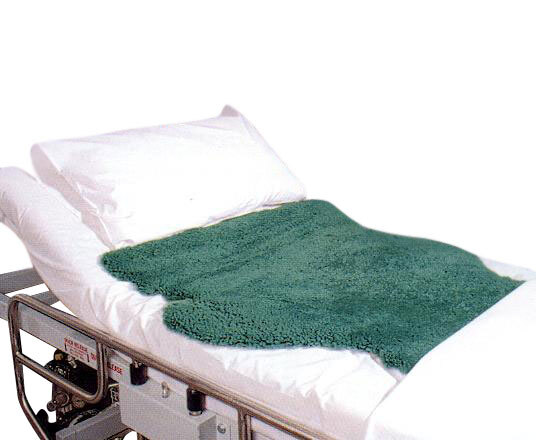
We stock two AS4480.1 HiTemp UR medical sheepskins, both green and stamped on the back:
| Sheepskin | Size | Shape and pile | Best for |
|---|---|---|---|
| M102 Australian Medical Sheepskin Overlay | about 38" x 24–26" | natural sheepskin shape | bed, chair or recliner; easy to move between them |
| M102C Australian Medical Sheepskin | 24" x 36" (60 x 90 cm) | rectangular, even 30 mm pile | bed; protects from the shoulders to below the buttocks |
The M102C also comes in the HiTemp Bedsore Prevention Package (M104A) with a foot-of-the-bed wool pad and a bottle of Woolskin. You can see all of them together in our AS4480.1 sheepskin collection.
AS4480.1 FAQs
What makes a sheepskin medical grade?
A sheepskin is medical grade when it is made and tested to AS4480.1, the Australian Standard for medical sheepskins. That covers wool fiber diameter, pile height, softness, tannage and washability, and a compliant skin carries the AS4480.1 stamp on its leather back.
Is AS4480.1 still current?
Yes. Standards Australia lists AS 4480.1-1998 as a current standard, and medical sheepskins are still made and stamped to it.
What does CSIRO stand for?
CSIRO stands for the Commonwealth Scientific and Industrial Research Organisation, Australia's national science agency. Its Leather Research Centre coordinated the development of AS4480.1.
Why are medical sheepskins green?
Medical sheepskins are green because AS4480.1 sets a wool color for Australian institutional use, which makes a HiTemp medical sheepskin easy to recognize. Color alone is not proof, though: always look for the stamp.
What is the difference between medical grade sheepskin and regular sheepskin?
Medical grade sheepskin is made to AS4480.1, with a dense pile and leather that survives hot washing; regular sheepskin is made for comfort or decoration and is often not washable at all. Our buyer's checklist shows how to tell them apart.
Is medical grade sheepskin good for bed sores?
Yes, for prevention in people at low to moderate risk: in the 2004 trial, patients on an AS4480.1 sheepskin developed new pressure ulcers at less than half the rate of patients on usual care. For an existing sore, ask a nurse or doctor.
Can babies sleep on a medical grade sheepskin?
No. Babies should always sleep on their backs on a firm, flat surface with nothing in the crib but a fitted sheet, as the NIH Safe to Sleep campaign advises. A lambskin is for supervised awake time, the stroller or play.
How long does an AS4480.1 sheepskin last?
An AS4480.1 sheepskin lasts for years with the right care. Ours are warranted for at least 50 washes in Woolskin; see how to wash and care for your sheepskins for the steps.
The short version
AS4480.1 is the Australian Standard, published by Standards Australia in 1998 with research coordinated by the CSIRO, that defines a medical grade sheepskin. It tests the wool, the leather, the size and how the skin survives hot washing, and compliant skins carry a stamp showing the grade (such as HITEMP UR), the standard number, the size and the maker. The clinical trials behind medical sheepskin used these skins, which is why the stamp is worth checking for. Questions about which one to choose? Contact us; we've been answering them since 1988.