A bed sore on the elbow is a pressure sore that forms where the point of the elbow presses or rubs on the mattress, a bed rail or an armrest for too long, and it usually starts as a discolored patch that doesn't fade when pressed. Elbows are a less common site than the tailbone or heels: in a US survey of critical care patients in 2018 and 2019, the elbow accounted for 63 of 3,642 hospital-acquired pressure injuries (1.7%). That is why they get missed. Down-Under Wool has supplied medical sheepskin to caregivers since 1988, and a sheepskin elbow pad is one part of keeping elbows safe; positioning, gentle moving and daily skin checks do most of the work.
Why do elbows get bed sores?
Elbows get bed sores because there is very little tissue between the skin and the bone. MedlinePlus explains that pressure sores tend to form where skin covers bony areas with less padding, and lists the elbow with the buttocks, hips and heels. The NHS names the elbows among the usual sites and says the chance is higher for anyone who has difficulty moving.
The international pressure injury guideline (NPIAP, EPUAP and PPPIA, 2026) says areas such as the elbows and wrists are vulnerable but easily overlooked, and asks carers to check all pressure points after each repositioning. Our guide to pressure points maps every risk area; this post covers the elbows only.
What puts pressure and friction on the elbows?
Ordinary positions and movements, repeated all day:
- Lying on the back with the arms on the mattress. The elbows carry the weight of the arms for hours.
- Lying on the side. The guideline's table of pressure points by position, written for surgery, lists the elbow for lying on the back, on the side and face down.
- Pushing up with the elbows. Shuffling up the bed on the elbows drags skin across the sheet. MedlinePlus says never drag yourself to change position, because dragging may cause skin breakdown.
- Sliding down a raised bed, then pushing back up. MedlinePlus advises keeping the head of the bed at no more than 30 degrees.
- Bed rails and armrests. An arm resting against a hard rail or chair arm for hours has the same problem as one on a hard mattress.
- Wrinkled sheets. MedlinePlus says sheets should be dry, smooth and free of wrinkles and objects.
Pressure, shear and friction are explained in our post on the causes of pressure sores.
What does a bed sore on the elbow look like?
An early bed sore on the elbow is a discolored patch that stays the same color when you press it, and the skin may feel warm, spongy or hard. The NHS says the patch is usually red on white skin, or purple or blue on black or brown skin, and may hurt or itch. Redness is harder to see on darker skin, so feel for warmth and texture too.
| What you see or feel | What it can mean | What to do |
|---|---|---|
| Patch that doesn't change color when pressed | An early pressure ulcer (NHS) | Keep weight off the elbow; tell the nurse or doctor |
| Warm, spongy or hard skin; pain or itching | Early signs of a pressure ulcer (NHS, MedlinePlus) | Keep weight off it; report it |
| Dark purple or maroon area, maybe a blood-filled blister | Possible deep tissue injury, which can quickly get worse (MedlinePlus) | Call the nurse or doctor the same day |
| Blister, broken skin or an open sore | The sore has broken the skin | Call the nurse or doctor; don't treat it yourself |
The NHS notes that ulcers usually develop gradually but can appear over a few hours. For what the stages mean, see our page on bed sores.
How do you prevent bed sores on the elbows?
You prevent bed sores on the elbows by keeping weight off them, moving the person without dragging and checking the skin every day:
- Check the elbows daily. MedlinePlus lists them among the areas to check head to toe every day.
- Support the arms on pillows. When the person lies on their back, MedlinePlus advises a pillow or piece of foam under the elbows.
- Change position every 1 to 2 hours (MedlinePlus), and move the arms too. See how often to turn a bedridden patient for a schedule.
- Keep the head of the bed at 30 degrees or less, so there is less sliding and pushing back up.
- Keep sheets smooth and dry.
- Keep elbows off hard edges. Move the arm away from bed rails and hard armrests, or pad them.
The routine for the rest of the body is in our checklist on how to prevent bed sores at home.
How should you protect the elbows when repositioning someone?
Lift rather than drag, then check the elbows once the person is settled. The guideline recommends lifting instead of dragging to avoid friction and shear, and using equipment such as low-friction transfer sheets. MedlinePlus says anyone moving another person should lift them or use a draw sheet.
- Use a draw sheet or slide sheet so the arms and back aren't pulled across the bed.
- Get help rather than hauling someone up the bed alone.
- Look at both elbows after each turn.
- Watch how the person moves themselves. The guideline asks carers to check that self-repositioning avoids friction and shear; a nurse or physical therapist can teach a safer way.
The guideline also suggests considering low-friction fabrics for people at risk who can't reposition themselves, though it rates that evidence as very low certainty.

Where does wool padding fit in?
A wool pad is one layer on top of positioning and turning, not a replacement. It puts something soft and dry between the elbow and the sheet, rail or armrest. We found no trial of elbow padding on its own; the strongest wool evidence is from beds, where a 2004 trial of 441 patients at a Melbourne teaching hospital found 9.6% on an Australian Medical Sheepskin developed a pressure ulcer, against 16.6% on standard care.
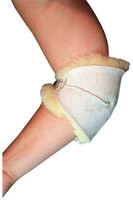
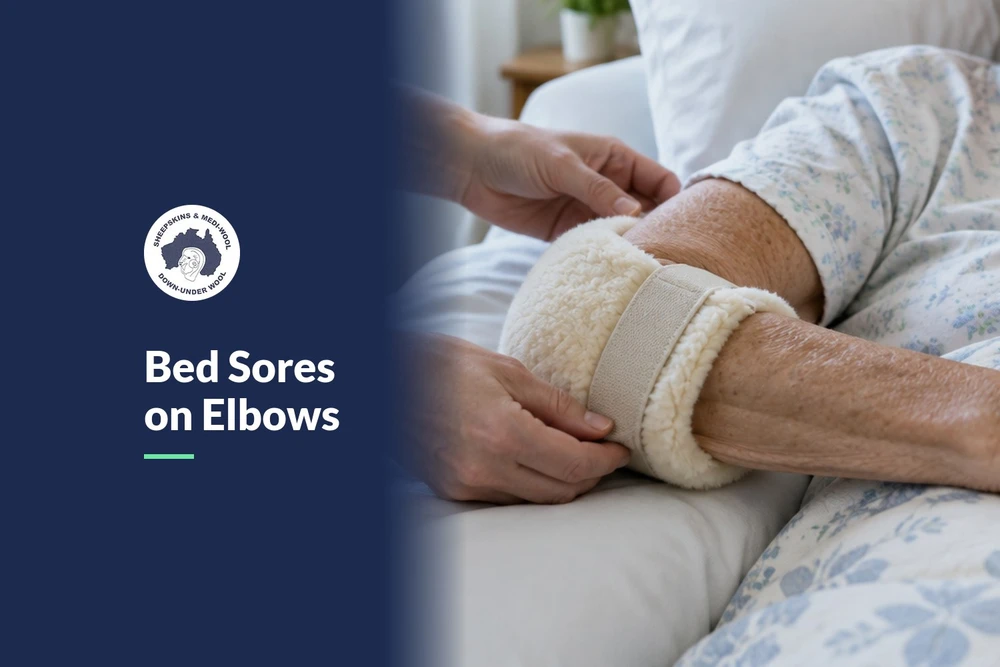
- Medical Sheepskin Elbow Pad (M110). Beige medical sheepskin with a 30 mm pile and a Velcro strap. It fits all elbows and is sold singly, so order two for both arms. Hand wash in Woolskin; air dry.
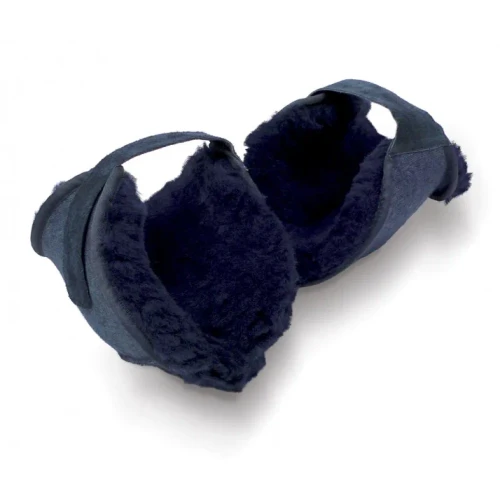
- Pressure Smart XD1900 (SC110B). The XD1900 elbow protector has a denser Merino pile that forms a soft cup around the elbow. Sold in pairs; machine wash in Woolskin, air dry.
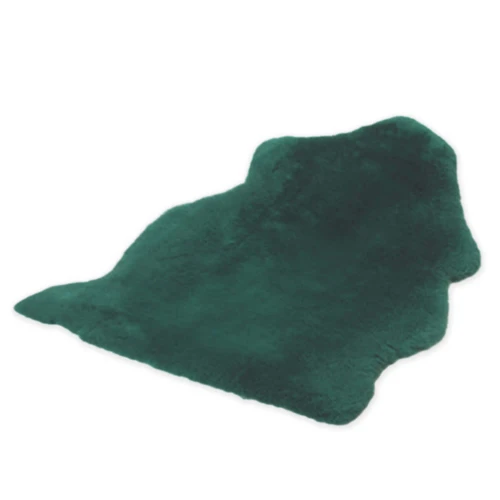
- Wool under the body. The hospital bed nursing fleece (F102) covers the whole mattress of a 35" x 80" hospital bed, so the arms rest on wool too. The Australian Medical Sheepskin overlay (M102) is about 38" x 24-26" and urine resistant.
- Wheelchair arms. Wool armrest supports cover hard wheelchair arms; for chairs at home, see medical sheepskin for recliner chairs.
Fasten straps snugly, not tight, and look under the pad at every turn. See how to wash sheepskin to keep it soft.
When should you call a nurse or doctor?
Call a nurse or doctor as soon as you think a sore is starting; the NHS advises getting any suspected pressure ulcer checked. MedlinePlus says to contact the provider right away if redness or a skin change lasts more than a few days, or becomes painful, warm or drains pus. The NHS says to get urgent help for:
- hot, swollen or red skin (it can look blue or purple on brown or black skin)
- pus coming from the sore
- a high temperature
- severe pain, or pain that is getting worse
How is a pressure sore on the elbow treated?
A pressure sore on the elbow should be assessed and treated by a nurse or doctor, who decides on cleaning and dressings. What the sources give caregivers is keeping pressure off it: MedlinePlus advises relieving pressure with pillows or foam, avoiding positions that press on the sore and not sliding when moving. Don't treat broken skin yourself.
Bed sores on elbows FAQs
Can you get a bed sore on your elbow?
Yes. The NHS lists the elbows among the bony places where pressure ulcers usually form, especially in people who have difficulty moving.
Are pressure sores on the elbow common?
Less common than on the tailbone or heels: in the US critical care survey, elbows were 1.7% of hospital-acquired pressure injuries, against 33.2% for the sacrum and tailbone and 12.6% for the heel.
What does a stage 1 pressure sore on the elbow look like?
Unbroken skin with a discolored patch that doesn't fade when pressed, red on white skin or purple or blue on darker skin, that may feel warm, spongy or hard.
Should you put a pillow under the elbows in bed?
Yes, when the person lies on their back. Don't put pillows under the knees, which MedlinePlus says presses on the heels.
Can you get bed sores on your arms?
Yes, mostly over the elbows. The guideline also names the wrists as easily overlooked, so check both.
How do you treat a pressure sore on the elbow?
Ask a nurse or doctor. Until they see it, keep all weight off the elbow and don't drag the arm across the sheet.
The short version
Elbows have almost no padding, so check them at every turn. Rest the arms on pillows, keep the head of the bed low, lift instead of dragging and add wool where an elbow rests on something hard. Call a nurse or doctor at the first patch that doesn't fade. Compare bed sore prevention products by body area, or contact us for help.