
A bedridden patient is usually turned every 2 hours, day and night, but that figure is a starting point, not a fixed rule. The current international pressure injury guideline (2026) says each person's schedule should be set for them, and suggests every 2 or 3 hours for most people at risk who lie on a suitable pressure-redistributing mattress. Down-Under Wool has supplied medical sheepskin to caregivers since 1988; below are the guidelines, safe turning steps and a printable schedule.
How often should you turn a bedridden patient?
Turn a bedridden patient at least every 2 hours unless a nurse has set a different schedule. Guidelines written for nurses ask for a schedule set for the person, based on how well they move, their skin and their mattress:
| Source | What it says about how often to turn |
|---|---|
| MedlinePlus (US National Library of Medicine) | Every 2 hours; its pressure injury page says every 1 to 2 hours. |
| NICE guideline CG179 (UK) | Adults at risk: often, and at least every 6 hours. High risk: at least every 4 hours. Write the schedule down. |
| International guideline (NPIAP, EPUAP, PPPIA, 2026) | A schedule set for the person; every 2 or 3 hours for most people at risk on a suitable mattress; don't routinely stretch it to 4 to 6 hours. |
| Cochrane review (2026 update) | Unclear whether 2, 3, 4 or 6 hours makes a difference; base it on condition, comfort, preferences and mobility. |
NICE's 4 and 6 hours are maximum gaps, not targets. The 2026 edition, which replaced the 2019 guideline, rates its evidence on turning frequency as very low certainty, so the nurse who knows the person makes the final call.
Where does the 2-hour rule come from?
The 2-hour habit grew out of hospital nursing, not from a trial testing 2 hours against other intervals. The British Geriatrics Society credits nurse Doreen Norton's 1950s research with showing that turning patients prevented bedsores, and turning at least every 2 hours followed.
In the TURN study (Bergstrom and colleagues, 2013), 942 nursing home residents on high-density foam mattresses were turned every 2, 3 or 4 hours for 3 weeks. Only 2.0% developed a pressure ulcer, all superficial, and the schedule made no significant difference. Those residents were turned consistently and checked weekly, so don't turn less at home without your nurse's agreement.
Does the mattress change how often you need to turn?
Yes, but only a nurse should lengthen the gap between turns. The international guideline says to keep turning on any surface: the interval may be adjusted to the mattress and how the skin responds, but no surface fully replaces turning. NICE advises a high-specification foam mattress for adults at high risk at home.
In a 2005 nursing home trial (Defloor and colleagues), residents turned every 4 hours on viscoelastic foam had fewer pressure ulcers of grade 2 or worse (3.0%) than the other groups (14.3% to 24.1%), which included 2- and 3-hourly turning on a standard mattress.
A medical sheepskin lies on top of the mattress. In a 2004 randomized trial of 441 patients at a Melbourne teaching hospital, 9.6% of patients given an Australian Medical Sheepskin developed a new pressure ulcer, compared with 16.6% on standard care. That trial did not test turning intervals, so it does not show that a sheepskin lets you turn less often.
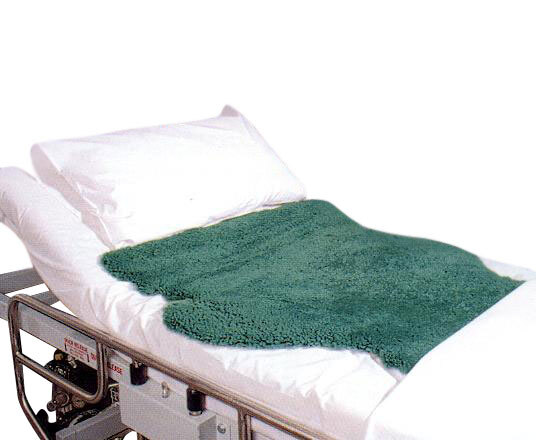
Our Australian Medical Sheepskin Overlay (M102) is made to AS4480.1, about 38" x 24-26", urine resistant and hot-washable, and works best with the skin directly on the wool. For a whole hospital-bed mattress, the Hospital Bed Nursing Fleece (F102) is a 35" x 80" Merino fleece with an elasticized skirt. More options: best mattress topper for bed sores.
Which positions should you use?
Rotate between the back, a 30-degree tilt to the left and a 30-degree tilt to the right. See pressure points for pressure sores for which bony points bear weight in each position.
- 30-degree tilt. Roll the person onto their side, then let them lean back about a third of the way toward flat against a pillow or wedge along their back. The international guideline suggests this angle because it takes weight off the tailbone without loading the hip bone, and advises against lying fully on the side (90 degrees). A pillow under the upper leg, slightly forward of the lower one, keeps them steady.
- Head of the bed at 30 degrees or lower. Lying flatter stops the body sliding down the bed (MedlinePlus). Some people need it higher, such as those at risk of inhaling food; follow the doctor's advice.
- Float the heels. Lay a pillow lengthwise under the calves, knees slightly bent, so the heels hang clear of the mattress; rolled towels under the ankles press on the back of the foot instead. A medical sheepskin heel pad (a cup of Merino wool with a hook-and-loop strap) does not lift the heel, so float the heels as well. More options: heel protectors for bed sores.
How to turn a bedridden patient at home, step by step
Explain, lay the bed flat, roll the person toward you from the shoulder and hip, then prop them with pillows. These steps follow MedlinePlus on turning patients over in bed and moving them up the bed:
- Explain first; ask them to help if they can.
- Set the bed at a height that saves your back, and make it flat.
- Use a slide sheet or draw sheet (a bed sheet folded in half). Moving someone up the bed takes at least two people.
- Roll, don't drag. Stand on the side they will turn toward. Cross their far ankle over the near one, lay their far arm across their chest, then, with one hand on the shoulder and one on the hip, gently pull them toward you, shifting your weight from front foot to back foot. Dragging causes friction and shear, two causes of pressure sores.
- Set the tilt: pillow behind the back, pillow between the knees and ankles, head in line with the spine, no arm trapped underneath.
- Clear the bed: take the slide sheet out, smooth the sheets, remove anything underneath (a phone, cutlery, coins).
- Check the skin you just took the weight off, and note the time and position.
A 24-hour turning schedule you can print
This schedule rotates every 2 hours from 8 am. If the nurse sets 3 hours, use 8, 11, 2, 5 and so on. At each turn, check the skin that was carrying the weight.
| Time | Turn to | Check (weight just came off) | Skin OK? / initials |
|---|---|---|---|
| 8 am | Back, heels floated | right hip, shoulder, ear, knee, ankle | |
| 10 am | Left 30° | tailbone, heels, shoulder blades, head | |
| 12 pm | Right 30° | left hip, shoulder, ear, knee, ankle | |
| 2 pm | Back, heels floated | right side | |
| 4 pm | Left 30° | tailbone, heels | |
| 6 pm | Right 30° | left side | |
| 8 pm | Back, heels floated | right side | |
| 10 pm | Left 30° | tailbone, heels | |
| 12 am | Right 30° | left side | |
| 2 am | Back, heels floated | right side | |
| 4 am | Left 30° | tailbone, heels | |
| 6 am | Right 30° | left side |
Each turn is a good time to change wet pads too (see bed sore prevention in incontinent patients). For the rest of the daily routine, see our checklist on how to prevent bed sores at home.
Turning at night without wrecking everyone's sleep
Most people at risk still need turning at night, but discuss the night schedule with the nurse: the international guideline asks nurses to weigh unbroken sleep, for the person and the caregiver, against more frequent turns.
- Combine each night turn with a pad check, so you wake the person once, not twice.
- Between full turns, make small shifts: move a pillow slightly, or bend or straighten the legs a little.
- Stretch the night gap only if the nurse agrees and the skin stays healthy at each check.
- If you can't keep up, ask about home nursing, respite care or equipment.
What if the person refuses to turn or is in pain?
Tell the nurse or doctor, and ask about pain relief before turns. The AHRQ pressure ulcer toolkit suggests explaining why the turn matters, asking which position they like best, and making small weight shifts each time you go into the room. For someone with dementia, the guideline suggests distraction, music and calm reminders. In end-of-life care, comfort comes first, and the schedule is a choice the person and family make with the care team.
When should you call a nurse or doctor?
Call a nurse or doctor if you see redness or sores, or if you can't keep to the schedule. The NHS lists the early signs of bed sores:
- discolored patches that don't change color when pressed (red on white skin, purple or blue on black or brown skin);
- skin that feels warm, spongy or hard;
- pain or itching in that area.
Get help the same day for hot, swollen skin, pus, a high temperature, or severe or worsening pain. Keep weight off any red area, and don't treat broken skin yourself: ask a nurse or doctor.
Turning a bedridden patient FAQs
Why do we turn patients every 2 hours?
Because turning takes pressure off the skin and keeps blood flowing, and 2 hours became the hospital habit decades ago. Trials have not shown that 2 hours beats 3 or 4 on a good mattress.
What is the 30-degree tilt position?
It is a side-lying position tilted back about a third of the way toward flat, propped with a pillow behind the back, which keeps weight off both the tailbone and the hip bone.
Can one person turn a bedridden patient alone?
Yes, one person can roll someone onto their side with the shoulder-and-hip method above, but moving them up the bed takes at least two people and a slide or draw sheet.
How often should you turn a hospice or dying patient?
As often as comfort allows. The guideline lets the person and family choose a schedule that suits their care goals, using small shifts of the head and limbs if full turns are too much.
What is a turning clock?
A chart showing which position is due at each hour. The schedule above works as one; pin it near the bed.
The short version
Start with every 2 hours, day and night, and let the nurse adjust it. Rotate back, left 30° and right 30°, keep the head of the bed low, float the heels, roll instead of dragging, and check the skin at every turn. For a washable wool layer on the bed, see our bedsore prevention packages, or contact us for help choosing.