
When someone starts spending most of the day in bed, a mattress topper is usually the first thing a family buys to protect their skin. But not every topper helps with bed sores. Some mostly add softness, some trap heat and sweat, and a few have good clinical evidence behind them.
This guide compares the main types of mattress topper and overlay for bed sores: egg crate foam, memory foam, gel, air and medical sheepskin. It explains what each one does well and badly, so you can pick the right one for the person you're caring for.
This guide is about prevention and comfort at home. If someone already has an open bed sore, or is at very high risk, ask their nurse or doctor which support surface they need.
Quick answer
- Low to moderate risk at home (spends long hours in bed but can still shift position): a medical sheepskin or dense wool overlay on a good mattress. It is one of the few toppers with randomised trial evidence for preventing pressure sores, and it also keeps skin drier and reduces friction.
- Just wants a softer bed: a thick, good-quality foam topper adds comfort, but on its own it isn't a pressure sore treatment.
- Egg crate foam: cheap and comfortable for a while, but thin, compresses quickly, and there is no good evidence that it prevents bed sores.
- High risk, can't move at all, or already has a sore: ask the nurse about an alternating pressure air mattress or another powered surface. A topper alone may not be enough.
What a mattress topper needs to do to help with bed sores
Bed sores (pressure sores, pressure ulcers) are caused by three things working together. A good topper should help with all three:
- Pressure. Spread the body's weight over a bigger area, so bony points like the base of the spine, hips, shoulder blades and heels aren't carrying it all.
- Shear and friction. When someone slides down the bed or is pulled up it, the skin stays put while the tissue underneath moves. A surface that lets the skin glide gently reduces that damage.
- Heat and moisture. Warm, damp skin breaks down much faster. A topper that traps sweat or urine against the skin makes things worse, even if it feels soft.
Most people only think about softness (pressure). Heat and moisture are where many foam and plastic-covered toppers fall short.
The main types of topper, compared
Egg crate (convoluted) foam toppers
Egg crate toppers are the cheapest and most common option. The bumpy surface feels soft at first and lets a little air flow underneath.
The problem: they are usually thin (2 to 3 inches of light foam) and flatten under the heaviest parts of the body, exactly where protection is needed. Research has not shown that they prevent pressure sores; one trial described convoluted foam overlays as widely used but of unclear effectiveness. Foam also holds heat and doesn't absorb moisture.
Verdict: fine for comfort, but don't rely on one to prevent bed sores.
Memory foam and high-density foam toppers
A thick memory foam or high-density foam topper moulds to the body and spreads weight better than egg crate foam. Good-quality foam mattresses do help: the international guidelines recommend high-specification foam over a standard mattress for people at risk.
The downsides: memory foam sleeps hot, holds moisture against the skin, and can make it harder for a weak person to change position because they sink in. Covers are often plastic or polyester, which add heat and sweat.
Verdict: a reasonable base layer, but heat, moisture and the "sinking" effect matter for someone in bed all day.
Gel toppers
Gel toppers or gel-infused foam stay cooler than plain memory foam and spread pressure fairly well. They can be heavy, firm at the edges and cold to start with, and they don't absorb moisture. The evidence for gel pads comes mainly from operating tables, not home beds.
Verdict: comfortable for some people, but no strong evidence for home bed sore prevention.
Air overlays and alternating pressure air mattresses
Air surfaces come in two kinds. Static air overlays are air cells you inflate. Alternating pressure air mattresses have a pump that inflates and deflates cells in turn, so no part of the body stays under pressure for long.
Alternating pressure mattresses are the usual choice for people at high risk, people who can't move themselves at all, and people who already have a pressure sore. They need power, they make some noise, and they can be uncomfortable or cold for some people. They are usually chosen together with a nurse or occupational therapist.
Verdict: the right tool for high-risk situations, but more than many people at low to moderate risk need.
Medical sheepskin and dense wool overlays
A medical sheepskin is not an ordinary sheepskin rug. Australian Medical Sheepskins are made to a standard (AS4480.1) with a very dense, deep wool pile that is tested for pressure reduction and can be machine washed at hospital temperatures. The person lies directly on the wool.
Wool helps with all three causes of bed sores at once:
- the deep, springy pile spreads pressure over the bony points;
- the fibres let the skin glide, reducing friction and shear;
- wool absorbs moisture away from the skin and lets air circulate, so the skin stays drier.
The evidence: unlike most toppers, medical sheepskins have been tested in randomised trials.
- In a 2004 trial of 441 hospital patients at low to moderate risk (Jolley and colleagues, Medical Journal of Australia), patients on an Australian Medical Sheepskin developed new pressure sores at less than half the rate of patients without one. The trial was open-label (staff knew who had a sheepskin), which is a limitation.
- A 2010 analysis that pooled three trials with 1,281 patients in hospitals and nursing homes found sacral (lower back) pressure sores in 5.4% of sheepskin users compared with 12.2% of those without.
- In the Dutch nursing home trial included in that analysis, about one in three users found the sheepskin too warm. That's worth knowing if the person runs hot.
Verdict: the best-supported topper for people at low to moderate risk, especially when moisture or incontinence is an issue. It's quiet, needs no power, and is machine washable.
Side-by-side comparison
| Topper type | Spreads pressure | Reduces shear | Keeps skin dry and cool | Trial evidence for bed sores | Best for |
|---|---|---|---|---|---|
| Egg crate foam | Low (flattens) | Low | Low | Not shown | Extra comfort only |
| Memory / high-density foam | Good | Low | Low (sleeps hot) | For full high-spec foam mattresses | A better base layer |
| Gel | Good | Low | Medium | Mainly on operating tables | Comfort, cooler than foam |
| Alternating pressure air | Very good | Medium | Medium | Yes, mostly in high-risk patients | High risk or existing sores, with a nurse |
| Medical sheepskin / dense wool | Good | Very good | Very good | Yes, low to moderate risk | Long hours in bed at home, incontinence |
Which topper is right for your situation?
- Recovering at home after surgery or illness, in bed most of the day: a medical sheepskin or wool overlay on top of their usual mattress.
- Incontinence: choose a urine-resistant (UR) sheepskin or wool pad that can be washed often. Avoid plastic-covered foam right under the skin. See bed sore prevention for incontinent patients.
- Hospital bed at home: a fleece made to fit a hospital mattress, so it doesn't bunch up when the bed is raised.
- Already using an alternating pressure mattress: check with the nurse or the mattress maker before adding layers on top, because extra layers can reduce how well it works.
- Heels at risk: no topper fully protects heels. Add heel protection too; see our guide to heel protectors for bed sores.
Our medical sheepskin and wool overlays
All of these are made from Australian Merino wool, are urine resistant or easy to launder, and are designed for the person to lie directly on the wool.
- Australian Medical Sheepskin AS4480.1 (M102C): a certified Australian Medical Sheepskin with a 30 mm dense pile, large enough to cover from the shoulders to below the buttocks. HiTemp washable and urine resistant. $239.68.
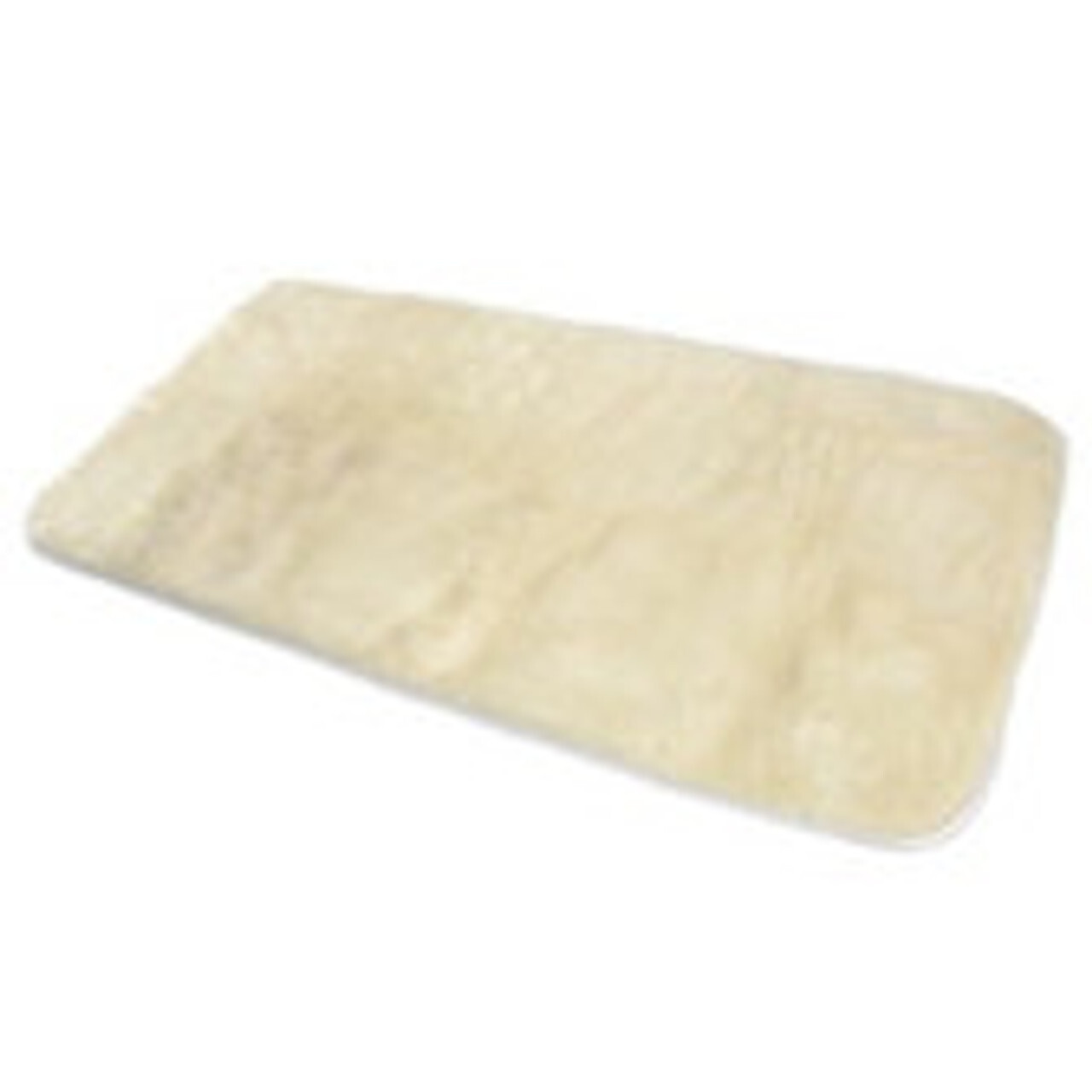
- Australian Medical Sheepskin Overlay AS4480.1 (M102): about 38" x 24", warranted for at least 50 washes in Woolskin. $221.23.
- Pressure Smart XD1900 Overlay (M102XD): 26" x 40" of dense Merino wool (1,900 g per square metre) knitted into a backing. Meets AS4480.1, very easy to launder, and easy to move from bed to wheelchair or recliner. $185.
- Superior Overlay XD (SC104XD): a full 30" x 60" XD1900 pad for whole-body coverage, urine resistant, machine wash and dry. $375.
- Hospital Wool Fleece Bed Pad (F103C): 30" x 60" of dense Merino pile (1,050 g/m²), shoulders to feet, urine resistant, machine wash and dry. $297.50.
- Hospital Bed Nursing Fleece (F102): 35" x 80" Merino fleece with an elasticised skirt that fits a standard hospital bed mattress. $195.
Want everything in one box? Our bedsore prevention packages combine an overlay with extras such as a foot or head pad and Woolskin wash.
Prices in USD at the time of writing; see each product page for the current price. Free shipping on orders over $180 to the USA & Canada.
Tips for getting the most from any topper
- Keep layers to a minimum. Every sheet, pad and blanket between the skin and the topper reduces how well it works. With sheepskin, the best protection comes from lying directly on the wool.
- Keep turning. No topper replaces regular changes of position, especially for someone who can't move themselves.
- Check the skin daily. Look at the base of the spine, hips, shoulder blades, elbows and heels for redness that doesn't fade when pressed. See our guide to pressure points for pressure sores.
- Wash wool the right way. Use Woolskin, which cleans, disinfects and conditions the wool, and don't over-dry it. See how to wash and care for sheepskins.
Frequently asked questions
Is egg crate foam good for bed sores?
Egg crate foam can make a bed feel softer, but it is usually too thin to protect bony areas once it compresses, and there is no good evidence that it prevents bed sores. It also traps heat and doesn't absorb moisture.
Is memory foam good for bed sores?
A thick, good-quality foam surface spreads pressure better than a standard mattress, and guidelines recommend high-specification foam for people at risk. But memory foam sleeps hot and holds moisture, and some people find it hard to move on. A breathable wool layer on top can help with heat and moisture.
Can I use a sheepskin on top of a foam mattress or topper?
Yes. A medical sheepskin is designed to lie on top of a mattress, and it works well on a good foam mattress. For an alternating pressure air mattress, check with the nurse or manufacturer first.
Isn't sheepskin too hot?
Wool breathes and absorbs moisture, so it usually feels drier than foam or plastic. Some people still find it warm; in one nursing home trial about a third of users said so. If heat is a concern, a lighter wool pad or the XD1900 knitted wool overlays are worth considering.
What's the difference between a medical sheepskin and a regular sheepskin rug?
Medical sheepskins are made to a specific standard (AS4480.1) for pile density, pressure reduction and washability at high temperatures. Ordinary sheepskin rugs aren't tested for this and often can't be washed often enough for medical use. Read more in what you should know about medical sheepskins.
Not sure which overlay suits your situation? Contact us with the bed size and a little about the person you're caring for, and we'll help you choose.


