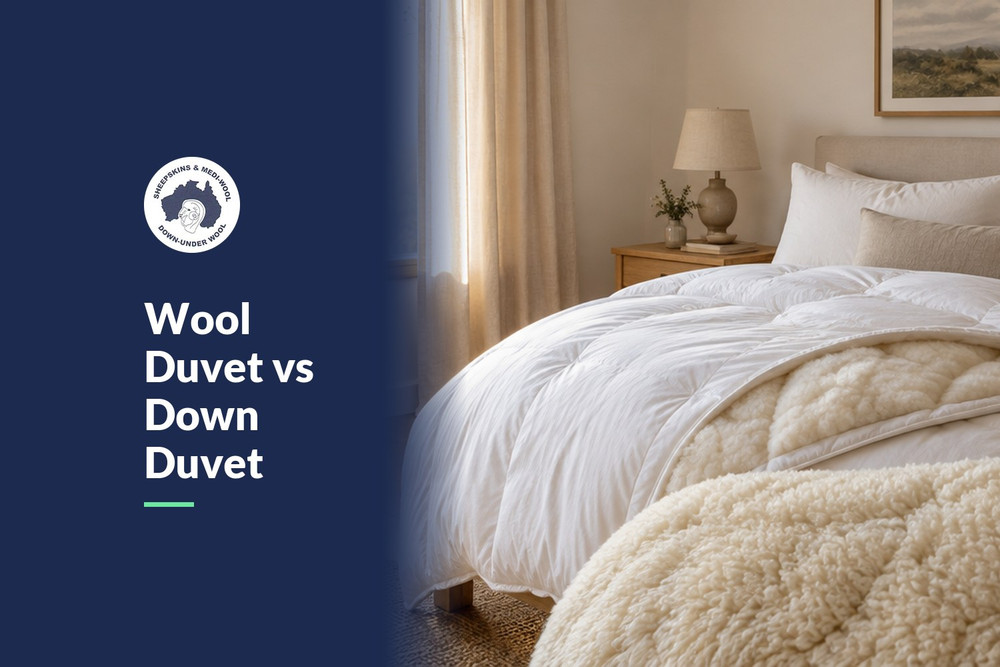
The main difference between a wool duvet and a down duvet is weight versus moisture: down gives the most loft and warmth for the least weight, while wool is heavier for the same warmth but much better at soaking up sweat and keeping your temperature steady. Wool can absorb up to 30% of its weight in water without feeling wet, which is why it suits hot sleepers and night sweats, while down suits anyone who wants the lightest cover on a cold night. Down-Under Wool has supplied wool and sheepskin bedding since 1988, and this guide compares the two fill by fill. (In the US, "duvet insert" and "comforter" often mean the same thing, so this applies to a wool vs down comforter too.)
Wool vs down duvet at a glance
Wool wins on moisture and temperature control; down wins on weight and loft.
| Factor | Wool duvet | Down duvet |
|---|---|---|
| Warmth | warm; nearly as lofty as down | very warm; the most loft for its weight |
| Breathability and moisture | absorbs and wicks sweat | traps heat very well; little research on sweat |
| Weight and drape | heavier for the same warmth; lies flatter | light and airy; puffs up around you |
| Allergies and dust mites | wool fiber not shown to be an allergen | feather duvets held less mite allergen than synthetic in one study |
| Washing and care | follow the label; ours is dry clean or spot clean | follow the label |
| Durability | use a duvet cover to cut down on cleaning | use a duvet cover to cut down on cleaning |
| Price | varies with wool grade and fill weight | varies with fill power and goose vs duck |
| Ethics and sourcing | look for the Responsible Wool Standard | look for the Responsible Down Standard |
Which is warmer, wool or down?
Neither fill is warmer by nature: a duvet's warmth comes mostly from its thickness, because the fill's job is to trap still air. Rebecca Van Amber, a textiles lecturer at RMIT University, explains in The Conversation that duvets of the same thickness give roughly the same warmth whatever the filling.
Down pulls ahead on how little it takes to get that thick. Down clusters give a lot of loft for very little weight, and higher "fill power" means bigger clusters that trap more air. Wool, she writes, doesn't quite match down for loft but isn't far behind. University of Sydney sleep researchers also describe a study in which, at 11°C (about 52°F), goose down gave the longest deep sleep, ahead of duck down and cotton.
Are wool duvets heavy?
Yes, a little: a wool duvet weighs more than a down duvet of the same warmth and lies flatter. Some people like that settled feel. For someone frail or in bed for long hours who is bothered by the weight of the covers, down or a lighter wool duvet is the kinder choice; if they kick off a puffy duvet because they overheat, wool usually suits them better.
Which is better for hot sleepers and night sweats?
Wool is generally the better choice for hot sleepers, because it pulls moisture away from the skin instead of letting it build up under the covers. The Science Learning Hub (University of Waikato) explains that wool absorbs water readily, helps remove sweat and releases moisture again as conditions change. The University of Sydney team adds that wool wicks moisture effectively and, in different thicknesses, works in summer and winter.
To be fair to down, the sleep evidence for the fill itself is thin. In a 2016 University of Sydney study funded by the wool industry, 17 young adults slept under wool or polyester duvets, and the duvet made no measurable difference to their sleep. The best-known wool vs down tests were commissioned by wool companies and are not published in a journal. For more on the research, see is it good to sleep on wool.
Sweating because the room or bedding is too warm is normal, but the NHS advises seeing a doctor if you regularly wake with soaking wet sheets.
Wool vs down for allergies and dust mites
Wool is a good option if you'd rather avoid feathers, but neither fill keeps dust mites away on its own. A 2017 review by Zallmann and colleagues in Acta Dermato-Venereologica found the evidence does not support wool fiber being an allergen; the itch some people feel comes from coarse fibers of roughly 30 microns and up. See our post on merino wool allergy for more.
Down is not automatically worse for dust mite allergy. In a New Zealand study of 65 duvets and 81 pillows (Mills and colleagues, 2002), synthetic duvets held about 15 times more dust mite allergen than feather duvets.
Whatever the fill, the Asthma and Allergy Foundation of America notes that mites can live in bedding even when the mattress and pillows are covered, and advises washing sheets and blankets weekly in water of at least 130°F. A wool duvet that can't go in a hot wash should live inside a cover that can. For pillows, see are wool pillows hypoallergenic.
Washing and caring for wool and down duvets
The care label decides how either duvet is washed, and some wool duvets, including ours, are dry clean or spot clean only. Van Amber also suggests looking for internal baffles (stitched walls) that keep the filling evenly spread.
- Use a duvet cover, so the duvet itself needs cleaning far less often.
- Spot clean spills early, and tell the dry cleaner when a duvet is wool-filled.
- Go easy with heat. Excess heat and agitation can damage fine wool.
Ethics and sourcing
Both are animal products, so ask how the animals were treated. Wool is shorn from sheep; down comes from ducks and geese. Textile Exchange's Responsible Down Standard certifies farms and slaughterhouses to welfare rules that ban live-plucking and force-feeding, and its Responsible Wool Standard covers animal welfare and land management, including non-mulesing of sheep. For the fiber itself, see what is wool.
Who should choose wool, and who should choose down?
Choose wool if you sleep hot, wake up sweaty or want one duvet across the seasons; choose down if you want the lightest, warmest cover for a cold room.
- Wool suits hot sleepers, people with night sweats, couples where one runs warm, and anyone avoiding feathers.
- Down suits cold sleepers in cool bedrooms and people who want the least weight on them.
- Feathers are not down. Feathers are heavier and trap less air, so feather blends are less lofty than pure down.
On the fence? Van Amber's tip is to layer: two lighter duvets are likely to be as warm as one thick one, and wool works best closest to your body. A wool topper does the same job from underneath.
Our wool duvet (T215)

Our wool duvet is made by Hemphill with hi-bulk, premium grade New Zealand wool, encased in breathable 200-count unbleached percale cotton rather than tightly woven down-proof cotton, which would hold back wool's moisture control. A minimal quilting pattern lets the wool regain its loft. Sizes: Twin 64" x 88", Double 80" x 88", Queen 89" x 90" and King 90" x 106".
Keep it in a duvet cover and have it dry cleaned when needed. Spot wash small spills in a laundry tub with warm water and Woolskin, rinse in cool water, let it drain, then hang it to dry.
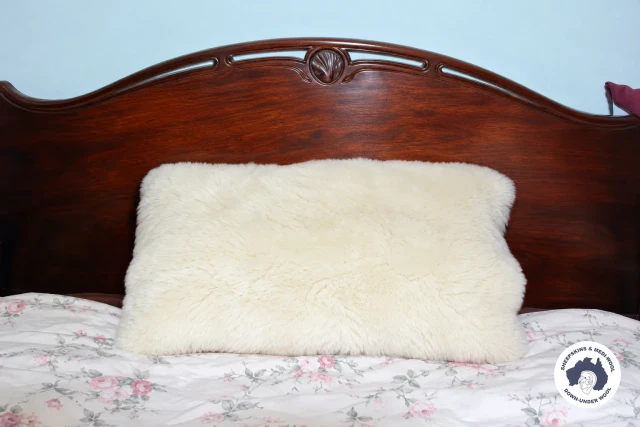
To match it, the Wool Pillow Cover (M129D) puts fine Merino wool under your head; a queen-size pillow slides inside, and it machine washes in Woolskin on a wool or gentle cycle. Browse our sheepskin bedding and merino wool bedding. A wool duvet also makes a thoughtful gift for an older parent who feels the cold; see our gifts for bedridden elderly guide.
Wool vs down duvet FAQs
Is a wool duvet better than down?
A wool duvet is better if you sleep hot or sweat at night; down is better if you want the lightest, loftiest warmth. Neither is better for everyone.
Are wool duvets warmer than down?
No, not by nature: duvets of the same thickness give roughly the same warmth whatever the fill. Down simply gets there with less weight.
Are wool duvets good for allergies?
Wool is a sensible choice if you want to avoid feathers, and research does not show wool fiber to be an allergen. Dust mites live in any bedding, so wash the cover and sheets weekly in hot water.
Can you wash a wool duvet?
Only if the care label says so; ours is dry clean or spot clean only. A duvet cover means the duvet itself rarely needs cleaning.
What is the difference between a wool and a feather duvet?
A feather duvet is filled with feathers, which are heavier and trap less air than down, so it is weightier than pure down; a wool duvet is filled with wool, which handles sweat well and contains no feathers.
Are wool duvets good for summer?
Yes, in a lighter weight. University of Sydney sleep researchers say wool, in different thicknesses, can be a good option in summer and winter.
The short version
Pick down for the lightest, warmest duvet in a cold bedroom. Pick wool if you sleep hot, wake up sweaty or want one duvet for most of the year, and accept a little more weight. Either way, use a washable cover, follow the care label and look for RWS or RDS certification. If wool sounds right, start with our wool duvet and wool pillow cover.