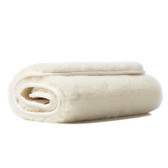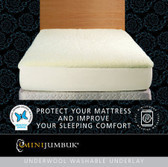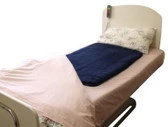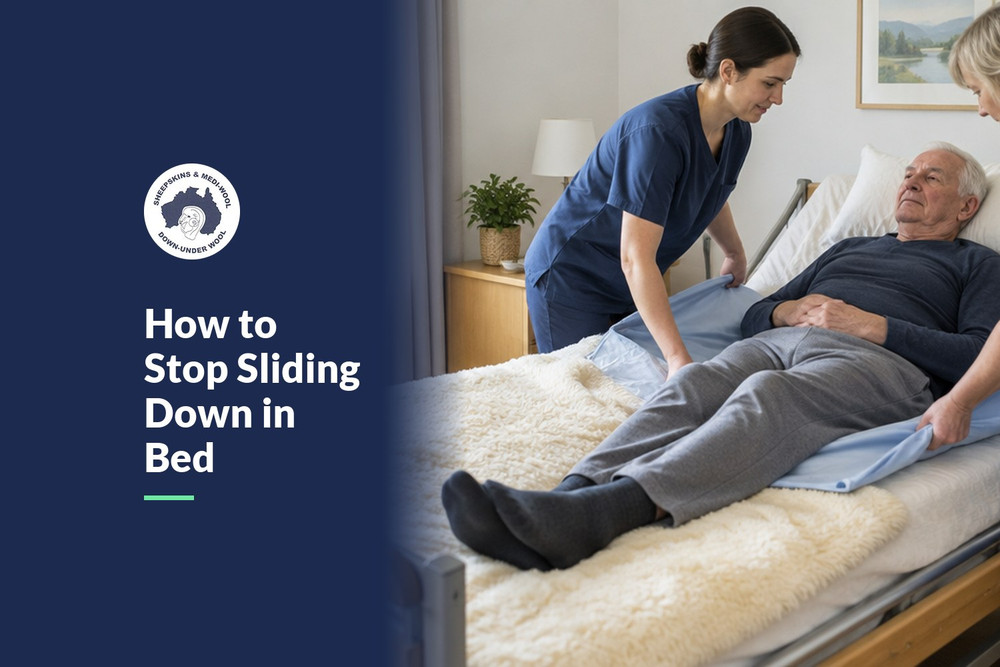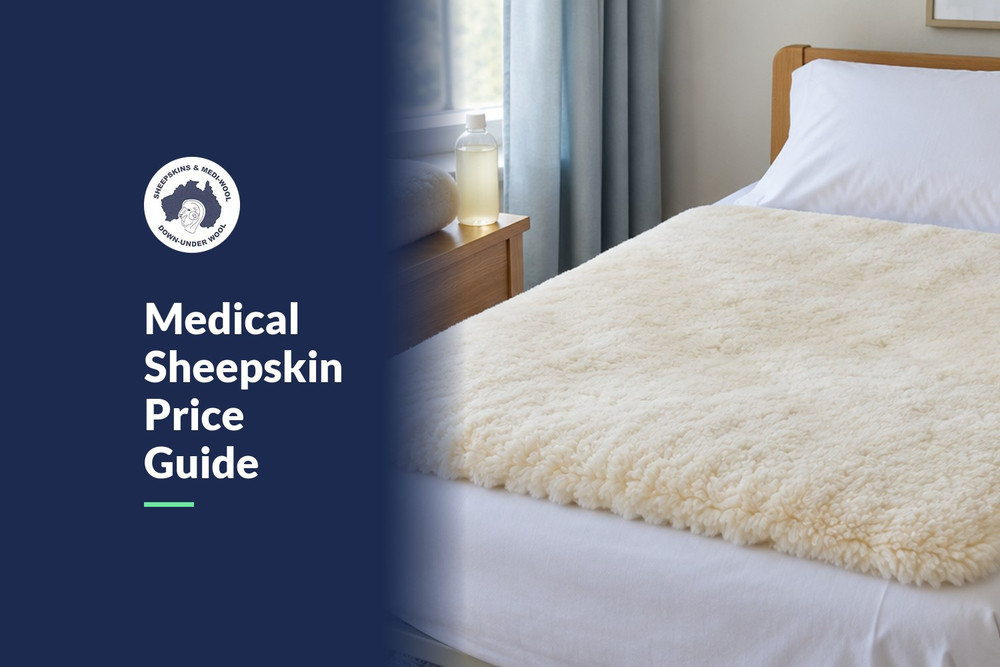

A pressure relief bed fleece is a pad of dense Merino wool pile that covers a mattress, so a person who spends long hours in bed lies on wool instead of a plastic, foam or synthetic surface. The wool cushions bony areas, absorbs sweat and reduces the friction and shear that break down fragile skin. Down-Under Wool has supplied wool and sheepskin pressure care products since 1988, and we stock two hospital fleeces for the bed: the Hospital Bed Nursing Fleece, which covers a standard 35" x 80" hospital mattress, and the denser 1,050 GSM Hospital Wool Fleece Bed Pad. This guide explains how they work, how they differ and how to use and wash them.
What is a hospital fleece?
A hospital fleece, also called a nursing fleece or medical fleece, is a bed or chair pad made by knitting pure wool into a fabric backing, so it looks and feels much like a medical sheepskin but is not a hide. Wool density is measured in grams of wool per square meter (GSM); the more wool, the more cushioning.
A wool hospital fleece is not the same as the polyester "polar fleece" used in jackets and blankets, or the synthetic pressure care fleeces some suppliers sell. Ours are 100% Merino wool. Our Hospital Wool Fleece range is made in Australia by MiniJumbuk and was created for medical use, where a pad needs to be dense, non-linting and highly absorbent.
How does a wool fleece help prevent pressure sores?
A wool fleece helps by reducing pressure, moisture and shear on the skin, the three main factors behind pressure sores. Mayo Clinic describes bedsores as injuries to the skin and the tissue below it caused by pressure over a long time, most often over bony areas such as the heels, ankles, hips and tailbone. It lists friction, which does more harm when the skin is moist, and shear, when the skin stays put while the bone beneath slides, as contributing causes.
- Pressure: thousands of springy wool fibers spread the load over bony points.
- Moisture: wool can absorb up to about a third of its own weight in moisture without feeling wet, and wicks it away from the skin.
- Shear and friction: the pile moves with the skin instead of dragging on it.
A fleece is one part of prevention, not all of it. Mayo Clinic also advises changing position about every two hours, keeping the skin clean and dry, and checking it every day for warning signs. If a sore has already formed, ask a nurse or doctor how to care for it. Our bed sores guide explains the stages and causes.
The strongest trial evidence is for medical sheepskin rather than wool fleece: in a 2004 trial of 441 hospital patients, those given an Australian Medical Sheepskin developed new pressure ulcers at less than half the rate of those without one (9.6% vs 16.6%). A wool fleece uses the same fiber in a pile that is easier to wash, but it has not been tested in a trial of that kind.
Hospital bed fleeces compared
Here is how our two hospital fleeces compare with the denser wool and sheepskin overlays we also stock:
| Product | Size | Wool density | Covers | Incontinence | Care |
|---|---|---|---|---|---|
| Hospital Bed Nursing Fleece (F102) | 35" x 80" (89 x 203 cm) | 550 GSM Merino | the whole mattress; elasticized skirt | not described as urine resistant | machine wash; dry on low heat |
| Hospital Wool Fleece Bed Pad (F103C) | 30" x 60" (76 x 152 cm) | 1,050 GSM Merino | shoulders to feet | urine resistant | machine wash; dry on low heat |
| Pressure Smart XD1900 Overlay (M102XD) | 26" x 40" | 1,900 GSM Merino | shoulders to below the buttocks | urine resistant | wash up to 80°C; dry on low heat |
| Australian Medical Sheepskin (M102C) | 24" x 36" | sheepskin, 30 mm pile | shoulders to below the buttocks | urine resistant (HiTemp UR) | machine wash; air dry |

Which hospital fleece should you choose?
Choose the Hospital Bed Nursing Fleece (F102) if you want the whole hospital bed covered in wool. Its elasticized skirt holds it on the mattress like a fitted sheet, so the person is on wool wherever they move, and it gives a softer surface for sleep.
Choose the Hospital Wool Fleece Bed Pad (F103C) if you want more wool under the body, or if incontinence is a concern. At 1,050 GSM it has about twice the wool of the F102 in each square meter, it is urine resistant, and it is long enough to protect the body from the shoulders to the feet, including the heels. It is also larger and more economical than an Australian Medical Sheepskin.
For the highest wool density, look at the 1,900 GSM Pressure Smart XD1900 range, or at a medical sheepskin. Neither fleece needs a pump or power, so both are silent, and they can be laid over an existing pressure-reducing mattress to add the feel and moisture control of wool. To weigh wool against foam and air, see our guide to the best mattress topper for bed sores.
How to use a nursing fleece on the bed
- Put the person directly on the wool. Protection comes from the wool, so it works best against the skin. The F102 can be covered with a fitted sheet if the user prefers, but that reduces the benefit.
- Protect the mattress. Under the F103C, use a waterproof "blue pad" if the mattress needs protecting from urine.
- Keep it smooth. Mayo Clinic warns that wrinkles in bedding can irritate the skin, so straighten the fleece when the bed is made.
- Keep turning. A fleece doesn't replace repositioning; follow the schedule the care team sets.
- Keep a spare. With two fleeces, one can be on the bed while the other is washed and dried.
Hospital fleece for wheelchairs and chairs
The same 1,050 GSM Hospital Wool Fleece comes in two wheelchair sizes: the 18" x 20" seat pad (F103A), which covers the seat of most wheelchairs and is sometimes used under the heels in bed, and the 18" x 36" seat cover (F103B), which covers the seat and back and is held by an elastic strap. Both are machine wash and dry. Our guide to sheepskin and lambswool seat pads compares them with the other wheelchair pads, and our nursing home care range lists the fleeces that stand up to institutional laundries.
How to wash a hospital wool fleece
A hospital wool fleece is machine washable and can go in the dryer, which is why it suits busy homes and care facilities.
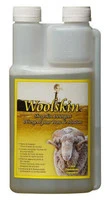
- Wash on the wool or gentle cycle with Woolskin, which cleans, conditions and disinfects the wool.
- Dry in the dryer at low heat with low agitation, for a short time.
- Don't over-dry. Wool does best with about 15% moisture left in it; finish drying on a rack if needed.
- Refresh the pile of the F102 by taking it off the mattress and giving it a good shake every week or so, and airing it outside on a windy day.
The F103C will stand up to repeated machine washing without losing its properties. For more on wool and sheepskin care, see how to wash sheepskin.
Hospital fleece FAQs
Is a wool hospital fleece the same as polar fleece?
No. Polar fleece is a synthetic polyester fabric. A wool hospital fleece is pure Merino wool knitted into a backing, which absorbs moisture in a way synthetic fibers do not.
Is a hospital fleece good for incontinence?
The Hospital Wool Fleece Bed Pad (F103C) is, because it is urine resistant and can be machine washed and dried as often as needed. Use a waterproof pad under it to protect the mattress. For more options, see our incontinence bedding.
Can you put a hospital fleece in the dryer?
Yes. Dry it at low heat with low agitation and take it out before it is completely dry, because wool does best with about 15% moisture left in it.
Do you need a fleece if you already have a pressure-relieving mattress?
You don't need one, but many people add one. A wool fleece adds a soft, absorbent layer that helps keep the skin dry, which a plastic-covered mattress can't do. Ask the care team before putting anything over a prescribed mattress.
Does a wool fleece cause itching or allergies?
Wool fiber has not been shown to be an allergen. A 2017 review in Acta Dermato-Venereologica found that itch from wool comes from coarse fibers (about 30 microns and thicker), not from an allergy; our hospital fleeces use fine Merino wool.
Can you put a sheet over a nursing fleece?
You can, but the fleece works best with the skin directly on the wool. If you use a sheet, keep it thin and smooth.
Is a hospital fleece the same as a medical sheepskin?
No. A medical sheepskin is a tanned hide with the wool attached, made to the Australian standard AS4480.1; a hospital fleece is wool knitted into a fabric backing. The fleece is larger for the price and easier to launder, while medical sheepskin has the longer pile and the clinical trial evidence.
The short version
A pressure relief bed fleece puts a layer of dense Merino wool between the skin and the mattress to reduce pressure, moisture and shear. Choose the full-bed F102 for whole-bed comfort, the 1,050 GSM F103C for more wool and incontinence, and keep repositioning and checking the skin every day. Questions about which fleece fits your bed? Contact us; we have been helping caregivers since 1988.